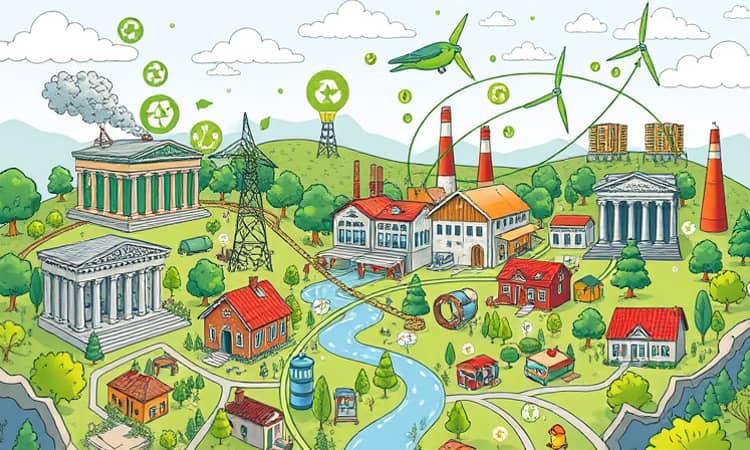
As the world confronts resource scarcity, climate change, and mounting waste, the concept of a circular economy has leaped to the forefront of sustainable development. Driven by innovative finance solutions, businesses can now transition from the traditional linear “take–make–waste” approach toward systems that regenerate natural capital and keep materials in use indefinitely.
In this exploration, we dive into the emerging credit models designed to fund circular strategies, mitigate risks of linear operations, and harness the full potential of sustainable finance.
Defining the Circular Economy
At its core, the circular economy challenges the prevailing “take–make–dispose” paradigm. Instead of depleting finite resources, it aims to design out waste and pollution, keep products and materials in continuous cycles of use, and restore ecosystems.
Key circular business models include reuse, repair, refurbishment, remanufacturing, recycling, product-as-a-service, leasing, refillable packaging, and take-back schemes. These models not only reduce environmental impact but unlock new economic opportunities across value chains.
The Financial Imperative for Circularity
Resource extraction and processing account for over half of global greenhouse gas emissions. Economics and climate science now converge on the need for rapid circular adoption:
- Significant climate mitigation via reduced virgin material use
- Enhanced resilience to raw material price volatility
- Pollution reduction and ecosystem regeneration
Scaling circularity demands significant investment and adoption of novel business models. As a result, private finance and credit markets have emerged as critical levers for this transition.
Innovative Credit Models for Circular Business
Financial institutions globally are designing bespoke credit instruments to support circular strategies. From targeted loans to performance-based bonds, these models align capital flows with sustainability outcomes.
Circular Economy Loans and Credit Lines
Use-of-proceeds loans and dedicated credit lines earmark funding for circular projects—recycling plants, remanufacturing lines, refillable packaging systems, and digital product passport implementation.
Sustainability-linked loans (SLLs) now incorporate circular key performance indicators (KPIs). Borrowers may face interest rate step-ups or step-downs tied to metrics such as percentage of recycled content, product durability indices, take-back rates, and reductions in virgin material usage. These targets can be aligned with reporting frameworks like the Corporate Sustainability Reporting Directive (CSRD).
Product-as-a-Service and Leasing-Backed Finance
Moving beyond ownership, banks and leasing companies are underwriting models that retain asset ownership with manufacturers. Through operating leases, pay-per-use financing, and outcome-based contracts, producers ensure that products are designed for longevity, upgradeability, and easy refurbishment.
Such arrangements require robust data platforms. Usage, maintenance, and residual value insights empower lenders to underwrite longer asset lifespans with confidence, while fostering a circular consumption culture.
Impact Bonds and Circular Transition Bonds
Impact bonds, including environmental and just transition bonds, unite public, private, and social-economy actors. Proceeds fund projects that generate measurable social and environmental benefits, such as inclusive repair networks for medical equipment.
Circular transition bonds are another frontier. These use-of-proceeds instruments finance companies’ shift from linear to circular models—capital investments in modular design lines, refillable packaging facilities, and recycling infrastructure. Bonds often include reporting commitments on avoided waste, recycled content, and lifecycle emission reductions.
Blended Finance and Risk-Sharing Strategies
Development institutions like the IFC de-risk circular investments in emerging markets through blended finance structures. By providing concessional capital tranches, guarantees, and first-loss buffers, they catalyze commercial lender participation in recycling, repair, and infrastructure projects.
- Public-private partnerships for municipal recycling and industrial symbiosis parks
- Residual value guarantees for long-life assets
- Performance insurance for refurbished product portfolios
Building a Data-Driven Circular Finance Ecosystem
Platforms enabling sharing, resale, repair, and refurbishment generate critical data on asset utilization, condition, and transaction histories. This information underpins advanced risk assessment models and unlocks innovative financing structures tailored to reused assets.
Financial institutions are embedding circular criteria across their internal policies, risk frameworks, and product design. By embedding circular criteria in policies, banks can engage clients on tailored transition pathways, monitor progress, and dynamically adjust lending terms.
Practical Steps for Businesses and Lenders
To harness these new credit models, organizations can:
- Conduct circularity audits to identify waste reduction opportunities
- Define clear circular KPIs aligned with global reporting standards
- Partner with banks to co-develop tailored financing solutions
By taking these actions, companies not only drive sustainability goals but can also unlock cost savings, new revenue streams, and stronger brand loyalty.
Conclusion
The shift toward a circular economy represents more than an environmental imperative—it is an economic and financial opportunity. Innovative credit models are now available to support every stage of the transition, from production and consumption to end-of-life recovery.
By leveraging these instruments and embedding circular principles into financial decision-making, businesses and banks can jointly orchestrate a transition that delivers climate mitigation, nature restoration, and resilient, inclusive growth.