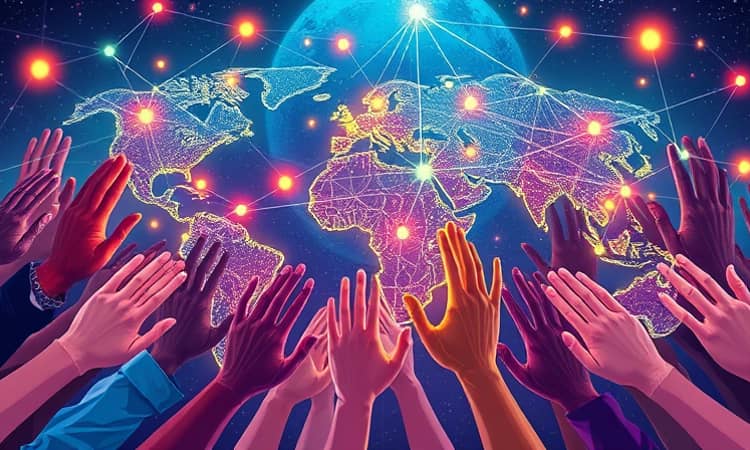
Decentralized Autonomous Organizations, or DAOs, represent a revolutionary shift in how communities collaborate, govern resources, and drive innovation.
By leveraging blockchain technology and smart contracts, DAOs empower members to participate in decision-making without intermediaries or traditional hierarchical structures.
Historical Context and Origins
The concept of a DAO emerged in the early days of Ethereum, where developers envisioned virtual entities managed by code rather than corporate charters.
Vitalik Buterin introduced this vision in the 2013 Ethereum white paper, describing autonomous communities that could pool funds, propose projects, and self-govern through immutable smart contracts.
The first major experiment in 2016 suffered a high-profile hack, yet it catalyzed intense innovation, leading to the flourishing of DeFi protocols, grant DAOs, and a rich ecosystem of governance experiments.
How DAOs Operate
At their core, DAOs rely on transparent protocols and permissionless participation.
Members join by acquiring governance tokens or NFTs, granting them the right to vote on proposals and share in the organization’s direction.
- Membership and Tokens: Access requires owning governance tokens or NFTs in a crypto wallet; tokens grant voting power and can be traded.
- Proposal and Voting Process: Participants submit proposals to a blockchain-based forum; a defined voting window determines whether smart contracts automatically execute approved actions.
- Treasury and Funding: DAOs raise capital by selling governance tokens, and treasuries release funds only after member approval, ensuring all code, votes, treasuries auditable on-chain.
- Launch Steps: Founders create smart contracts, distribute tokens or NFTs, and deploy contracts on a public blockchain to kickstart community governance.
Governance Models Explained
DAOs experiment with a spectrum of governance frameworks to balance decentralization, fairness, and efficiency.
Designing an effective DAO often begins with a clear constitution that defines member roles, voting rights, proposal structures, and execution mechanisms.
Benefits and Risks
DAOs offer transformative advantages but also face critical challenges that communities must address proactively.
- Transparency and Accountability: All transactions and votes are on-chain, visible to every participant in real time.
- Borderless and Inclusive: Anyone worldwide can join by acquiring governance tokens, fostering diverse global participation in governance.
- Automated Execution: Smart contracts remove intermediaries, reducing administrative costs and human error.
- Aligned Incentives: Token holders share in the platform’s success, encouraging long-term commitment.
- Security Vulnerabilities: Smart contract bugs can lead to exploits, as early DAO hacks demonstrated.
- Plutocratic Risks: Token-weighted systems can concentrate power among large holders.
- Participation Apathy: Inactive members may yield decisions to a vocal minority.
- Legal Uncertainties: DAOs often lack clear jurisdictional status, creating potential regulatory challenges.
Future Trends and Outlook
As of 2026, DAOs are branching beyond DeFi into areas like arts patronage, nonprofit grants, and decentralized media.
Emerging innovations focus on legal frameworks and anti-apathy mechanisms, court-style dispute resolution layers, and cross-chain interoperability.
Hybrid human-plus-code governance, coupled with on-chain identity solutions, promises to improve both trust and scalability, ushering in new forms of organizational coordination.
Conclusion
DAOs illustrate the power of code-driven communities where every stakeholder can shape outcomes, backed by transparent protocols and shared incentives.
From pioneering token-weighted votes to experimental quadratic and reputation-based systems, the DAO landscape continues evolving rapidly.
By understanding the mechanics, governance models, and trade-offs, innovators can design resilient DAOs that harness the best of decentralization while mitigating risks.
As we look ahead, DAOs stand poised to redefine collaboration, finance, and governance for a truly borderless and participatory future.