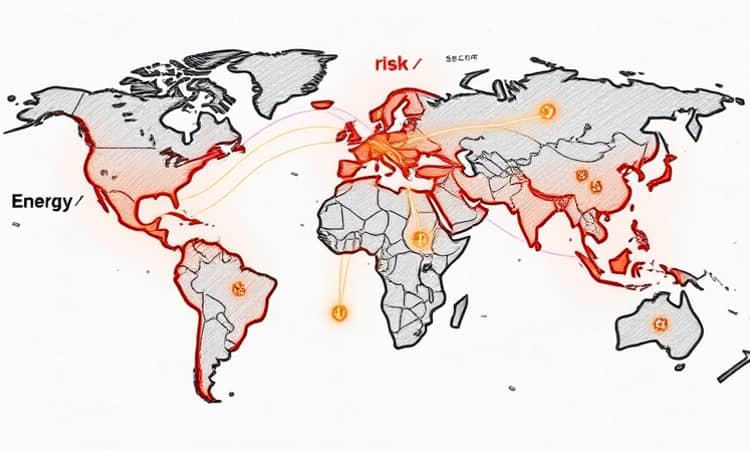
Global tensions, from wars to political polarization, increasingly drive credit markets in unpredictable ways. Understanding these dynamics helps lenders, investors, and policy makers navigate heightened uncertainty and capitalize on emerging opportunities.
Geopolitical Risk and Credit Spreads
Research shows that rises in the Geopolitical Risk (GPR) index have a profound impact on U.S. corporate credit spreads. When actual events such as wars or terrorist attacks occur—referred to as realized geopolitical actions—spreads widen more sharply than when threats alone rise. Caldara and Iacoviello (2022) find that these actions lead to a drop in firm operating performance and hit companies dependent on external finance the hardest.
In practice, a one-standard-deviation jump in the GPR index can add dozens of basis points to investment-grade and high-yield spreads alike, creating an environment of persistent market adjustments that can last for quarters.
Bank Lending Adjustments and Trade Credit Reliance
Banks respond to elevated GPR by tightening lending standards and reducing cross-border exposures. However, they often maintain credit flows via local foreign affiliates to mitigate expropriation risk. Foreign GPR spikes increase default probabilities across whole portfolios, especially for banks with extensive overseas operations.
- Cross-border lending falls sharply to high-GPR countries.
- Local affiliate lending serves as a substitute for direct loans.
- Domestic credit standards tighten in response to global spillovers.
Firms also pivot toward trade credit as short-term financing when bank credit becomes scarce. This reliance can cushion working capital needs but may expose smaller firms to higher supplier pricing and liquidity mismatches.
Sectoral Heterogeneity: Winners and Losers
Not all industries react the same way to geopolitical shocks. The table below summarizes key sector impacts observed during recent events:
For example, during the Russia–Ukraine war and the 2013 Crimea conflict, sharp GPR spikes led U.S. banks to cut direct lending to Russian borrowers, while affiliate channels remained active. In the Middle East tensions of 2025, oil soared, boosting energy but squeezing airlines and chemicals, with bank loan spreads holding at +408 basis points.
Climate-Related Geopolitical Tensions
Extreme weather events now serve as geopolitical amplifiers. In 2025, climate disasters caused $318 billion in economic losses, raising insurance premiums and depressing property values. Emerging markets face an annual adaptation funding need of $387 billion, straining budgets and sovereign creditworthiness.
These climate risks intertwine with traditional political tensions, creating multifaceted threats to financial stability. Central banks have acknowledged GPR’s role since 2019, incorporating risk assessments into stress tests and capital planning.
2026 Outlook: Resilience and Risks Ahead
Credit markets have shown resilience amid 2025 shocks, with record-rate-driven M&A activity and refinancing waves. Yet, several trends will shape credit in 2026:
- Political Polarization: Inward policies and fragmented governance lower predictability and growth potential.
- Emerging Market Vulnerabilities: Elevated credit risks despite high gold reserves.
- Non-Bank Financial Institutions: Private credit expansion to meet massive refinancing needs through 2028.
- Regulatory Developments: U.S. bank capital and stablecoin rules could alter funding costs.
Potential re-acceleration of inflation or labor market weakness could widen spreads further. Meanwhile, recent defaults (e.g., First Brands) link to fraud, not systemic or geopolitical shocks, suggesting no immediate crisis signal. The U.S. GDP is forecast to grow above 2%, underpinning moderate credit performance.
Strategies for Market Participants
To navigate this landscape, stakeholders can consider:
- Diversifying funding sources across bank, non-bank, and trade credit channels.
- Hedging or adjusting duration against spread volatility.
- Engaging in scenario analysis that integrates both political and climate risk dimensions.
By adopting a multi-faceted risk framework, lenders and investors can better anticipate credit stress points and seize opportunities in sectors poised for resilience or growth.
In an era where global events swiftly reshape financial conditions, staying informed on geopolitical trends and their credit implications is paramount. With targeted strategies and robust stress testing, market participants can build resilient portfolios that endure uncertainty and thrive amid shifting geopolitical tides.