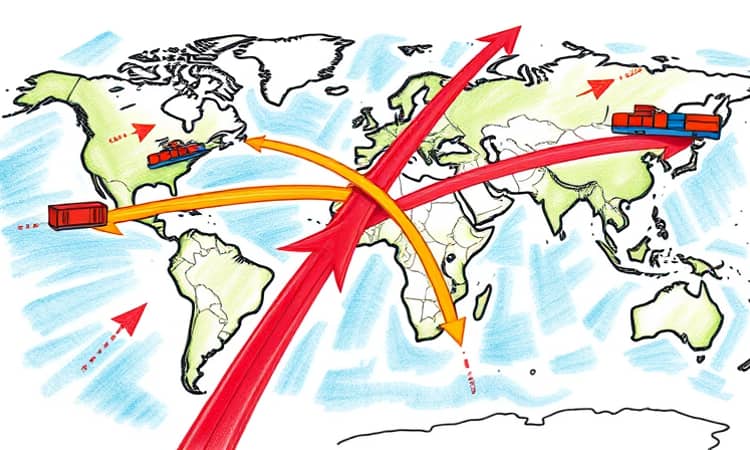
Global trade reached unprecedented highs in 2025, only to face a sharp deceleration in 2026. From record‐breaking volumes to “weaponized trade restrictions,” markets are entering a period of profound uncertainty.
In this article, we explore the forces reshaping commerce, the shifting alliances among trading partners, and practical strategies to help businesses and policymakers adapt.
The Shifting Global Trade Landscape
In 2025, world trade in goods and services surpassed $35 trillion, marking a 7% increase over the previous year. Yet forecasts for 2026 present a stark contrast: global trade volume growth is expected to slow to around 0.5–1%, compared with 4.2% in 2025.
The United Nations Conference on Trade and Development (UNCTAD) and the World Trade Organization (WTO) point to rising tariffs, geopolitical tensions, and tighter financial conditions as the chief culprits behind this marked slowdown.
Major Economy Growth Outlook
This table underscores the broader context: subdued global growth often translates into weaker trade expansion, setting the stage for heightened volatility.
Weaponizing Tariffs: The US Shockwave
April 2025 proved pivotal when the United States invoked the International Emergency Economic Powers Act (IEEPA) to impose sweeping 10% tariffs on global imports. Markets dubbed it “the year everything changed in global trade.”
Effective rates soared: according to KPMG, US tariffs climbed to near 15% by mid-2025, the highest since the 1930s. While exemptions and carve-outs for semiconductors and other strategic goods trimmed the headline figure, the impact remained profound.
- Across-the-board 10% duties on most imports.
- Exemptions for national security–critical sectors: semiconductors, high-end electronics.
- Targeted measures on China linked to fentanyl precursors.
These sudden measures prompted firms to scramble, front-loading of imports into the US and renegotiating supply contracts in anticipation of further tariff waves.
Retaliation and Global Tariff Escalation
Trade partners were quick to fire back. From Brazil to India, Mexico to the European Union, retaliatory tariffs emerged as a central feature of this new era of protectionism.
- Brazil: 40% duties on select manufactured and agricultural goods.
- India: up to 50% tariffs on targeted US imports.
- Mexico & Canada: 25–35% duties within USMCA frameworks.
- EU & allies: 15–20% on specific sectors.
These moves transformed tariffs from negotiating chips into structural regime of weaponized trade, fueling policy risk and legal battles, including US states suing to block national tariffs.
Regional Divergences Reshape Trade Patterns
Despite the tariff shock, global trade volume still grew by 4.2% in 2025, buoyed by resilience of intra-Asia trade and strategic rerouting. Yet as front-loading dissipates, 2026 is poised to be far weaker.
Asia remains the bright spot. Supply chains are regionalizing under “China+1” strategies, driving rapid growth in Vietnam, South Korea, and Malaysia. The Eurozone, by contrast, faces stagnation due to high energy costs and soft external demand.
UNCTAD warns that slower trade will hit commodity-exporting and manufacturing-dependent developing economies hardest, threatening growth and stability.
Winners and Losers across Key Sectors
Trade wars do not impact all industries equally. Semiconductors and high-tech machinery have been insulated through carve-outs and subsidies, while agricultural exporters face shifting demand and price pressures.
The global chip market is projected to reach $750 billion by 2026, and governments are deploying both sticks and carrots: tariffs to discourage offshore dependence, and massive subsidies to boost domestic capacity.
In agriculture, China’s pivot away from US soybeans has benefited Brazil, creating new agricultural realignment opportunities but punishing American farmers already contending with global oversupply.
Strategies for Navigating Market Uncertainty
In this fluid environment, businesses and policymakers must adopt resilient approaches to thrive:
- Diversify supply chains across multiple regions to reduce exposure.
- Embrace dynamic scenario-based planning to anticipate policy shifts.
- Invest in digital trade platforms and nearshoring partnerships.
Governments can ease tensions through targeted diplomacy, multilateral trade negotiations, and by reinforcing rules-based systems to curb protectionist excesses.
Conclusion: Charting a Course through Turbulence
Global trade wars have ushered in a period of profound uncertainty, where once-stable flows are disrupted by tariffs, geopolitical friction, and financial tightening. Yet within this disruption lie opportunities to build resilience, diversify partnerships, and harness innovation.
By understanding the shifting dynamics—from record highs to slowing growth, from tariff shockwaves to resilient regional hubs—stakeholders can navigate these choppy waters and emerge stronger in the new trading environment.