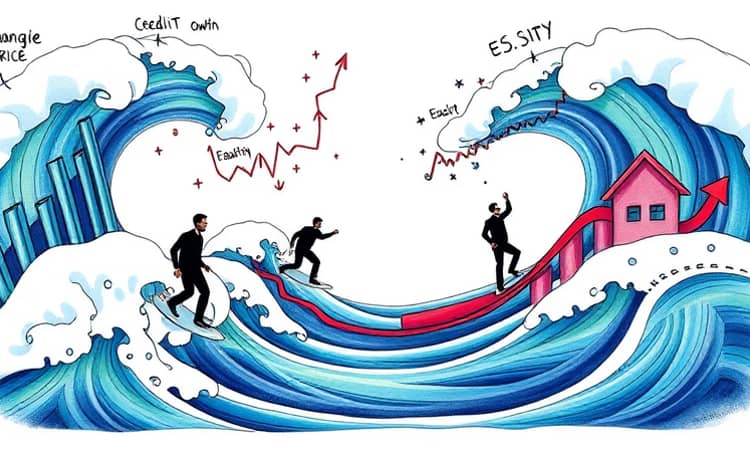
Financial markets ebb and flow in predictable yet powerful patterns. By learning to recognize and align with these patterns, investors and individuals can harness momentum rather than be swept away by it.
Decoding Business and Financial Cycles
The business cycle describes fluctuations in economic activity—GDP, employment, income, and profits—around a long-term growth trend. It unfolds in four classic phases: expansion, peak, contraction, and recovery.
In contrast, the financial cycle captures the longer-term boom-bust dynamics in credit and asset prices that often outlast business swings. It tracks medium- to long-term shifts in credit, housing prices, and equity values. Understanding both cycles offers a comprehensive map of economic terrain.
Business cycles typically span up to eight years, whereas financial cycles—especially when global forces intervene—can extend for 15–20 years from trough to trough. The interaction of credit growth, collateral values, and risk appetite generates phases of accelerating momentum and sharp reversals.
Mechanisms Behind Financial Momentum
Financial momentum thrives on reinforcing feedback loops. During an upturn, easier borrowing conditions and rising asset prices fuel optimism, which in turn encourages more lending and investment.
- Accelerated credit growth and asset valuations: Low interest rates and rising collateral unlock additional borrowing capacity, pushing prices higher.
- Pro-cyclical leverage and risk perceptions: Lax lending standards in booms tighten abruptly in busts, amplifying downturns.
- Search for yield: Declining returns on safe assets drive investors toward riskier instruments.
- Policy influence: Central bank rate cuts or hikes can ignite or dampen momentum by shifting borrowing costs.
Collateral feedback loops emerge when higher house or equity prices boost balance sheets, enabling further debt expansion. This cycle of leverage often peaks unexpectedly, leaving participants exposed when sentiment shifts.
Domestic vs Global Financial Cycles
Financial cycles operate at different scales. A domestic cycle revolves around local credit growth and house price dynamics shaped by national banks and regulations. It reflects macro-financial imbalances within one economy.
A global cycle emerges from synchronized capital flows, common risk appetite, and major central bank policies—particularly those emanating from financial hubs like the United States. These forces drive co-movement in international credit, asset prices, and interest rates.
Claudio Borio’s concept of a “tale of two cycles” highlights how domestic and global cycles interact but remain distinct. For example, global liquidity surges can inflate domestic property markets even as local fundamentals remain unchanged.
Strategies to Navigate Upturns and Downturns
Empowered by cycle knowledge, investors and households can adopt phase-aware strategies to optimize outcomes.
- Early-stage positioning: In recovery and early upturn phases, incrementally increase exposure to growth assets such as equities, real estate, and cyclical sectors.
- Peak-phase caution: As momentum matures and valuations become stretched, reduce leverage, secure profits, and reallocate to defensive sectors like utilities and quality bonds.
- Countercyclical rebalancing: Establish systematic rules to sell outperforming holdings and buy underperformers when they fall below target weights.
- Liquidity planning: Maintain clear boundaries for risk and liquidity so you can meet obligations without forced asset sales during stress.
For homeowners, monitoring credit-to-income ratios and mortgage rate trends can reveal tightening conditions ahead of price corrections. Refinancing to fixed rates or shortening maturities during booms can lock in favorable terms before cycles turn.
Practical Tools and Indicators
Combining financial and economic indicators provides early warnings of momentum shifts. Consider these measures:
Additional gauges include credit-to-GDP gaps, private sector leverage ratios, and credit spreads. A sustained widening of risk premia or flattening of credit growth often presages a slowdown.
Overlay these with business cycle indicators—unemployment trends, consumer sentiment, and inflation rates—to build a holistic dashboard. This multi-dimensional view enhances confidence in timing tactical adjustments.
Building Long-Term Confidence and Resilience
Mastering momentum demands both quantitative insight and emotional discipline. Volatile swings can tempt even seasoned participants into herd behavior at extreme valuations.
Construct well-diversified portfolios with strategic hedges by blending traditional stocks and bonds with alternative assets like commodities or managed futures. Such diversification smooths returns across financial cycles and reduces drawdown severity.
On a personal finance level, prioritize paying down high-cost debt during expansions. Establish an emergency fund that covers at least six months of expenses, ensuring you can weather downturn-induced income shocks without liquidating investments at depressed prices.
Set clear rules for portfolio adjustments based on indicator thresholds. For instance, if credit-to-GDP exceeds a historical norm by a predetermined margin, initiate defensive reallocations. Conversely, when leading indicators bottom and begin to recover, redeploy capital to high-conviction growth positions.
Regularly revisit and refine your approach. As global and domestic cycles evolve, new dynamics—such as shifts in regulation or technological disruption—may introduce novel momentum drivers. Stay informed and adaptable.
Conclusion: Riding the Waves with Purpose
Financial cycles may be inevitable, but being carried away by uncontrolled momentum is a choice. By understanding interactions between credit, housing, and equity markets and monitoring key indicators, you can transition from reactive to proactive stewardship of your financial future.
Whether you seek to grow a long-term portfolio or secure household finances, aligning your actions with cycle phases builds resilience and confidence. Let momentum be your ally rather than your adversary, guiding you through booms and busts with clarity and purpose.