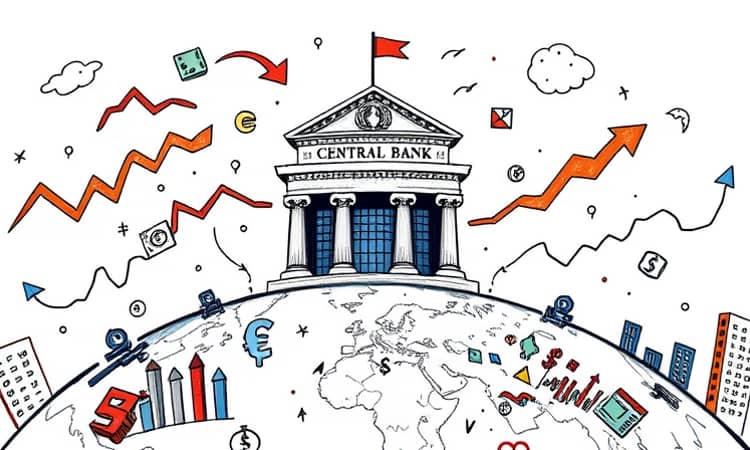
Central banks stand at the heart of the global economy, wielding immense power to shape financial stability and growth. From the Federal Reserve in Washington, D.C., to the European Central Bank in Frankfurt, these institutions guide national economies through shifting tides of growth and contraction. Far beyond simply printing money, they are managing the delicate balance between inflation, employment, and financial health for millions of people.
Every decision—from adjusting interest rates to purchasing long-term assets—echoes through currency markets, stock exchanges, and commodity prices. By understanding their roles and tools, individual investors, businesses, and policy-makers can anticipate market movements, mitigate risks, and seize opportunities. This comprehensive guide delves into central bank mandates, their powerful instruments, and practical strategies for navigating the ripples they create.
Understanding the Mandates and Objectives
Each central bank operates under a unique charter and legal framework, yet all share core objectives: controlling inflation, promoting sustainable growth, and ensuring financial stability. Some emphasize price stability and sustainable growth, while others focus on full employment or exchange-rate targets. These mandates define the goals that guide every open market operation and policy statement.
Across 222 institutions worldwide, the Federal Reserve remains the most influential, affecting 88% of foreign exchange transactions with its benchmark federal funds rate. Meanwhile, the European Central Bank uses three key rates—the Main Refinancing Operations Rate, the Marginal Lending Facility Rate, and the Deposit Facility Rate—to manage liquidity in the Eurozone.
Key mandates often include:
- Price stability
- Maximum sustainable employment
- Currency value preservation
- Financial system regulation
By clearly defining these mandates, central banks establish accountability and transparency, allowing markets to form expectations and reduce uncertainty. In turn, stakeholders can align investment decisions, corporate strategies, and policy analyses with anticipated central bank objectives.
Primary Tools and Their Far-Reaching Effects
Central banks deploy a toolkit that has grown increasingly sophisticated since the 2008 financial crisis. From classic interest-rate adjustments to large-scale asset purchases, each instrument serves to influence borrowing costs, liquidity, and expectations.
Adjusting benchmark rates is the most familiar tool. When rates rise, borrowing becomes costlier, cooling economic activity; when they fall, lending surges, fueling growth. Open Market Operations (OMO) work behind the scenes, adding or draining reserves from commercial banks to guide short-term rates.
In times of crisis or near-zero rates, traditional policy loses potency. That is when quantitative easing and forward guidance become essential. QE reduces the supply of longer-term assets, increasing their price and lowering yields. Simultaneously, clear forward guidance signals a commitment to keeping rates low, anchoring expectations and bolstering confidence.
Navigating Market Reactions and Investor Strategies
Every policy shift sends ripples through global markets. Investors who anticipate central bank actions can position portfolios to benefit or protect against volatility. Understanding these dynamics transforms uncertainty into opportunity.
Key market segments respond as follows:
- Forex markets react instantly to rate differentials
- Equity valuations adjust based on discount rates
- Bond yields shift to reflect new rate expectations
- Commodity prices move in response to currency strength
Practical strategies include:
- Monitoring central bank meeting calendars and minutes
- Analyzing speeches and press conferences for forward guidance
- Developing scenario-based forecasts for rate changes
- Implementing risk management through diversification and hedging
By combining quantitative models with qualitative insights into policy language, investors can discern subtle shifts in tone—often the earliest clues to future action.
Lessons Learned and Practical Insights
The post-crisis era has taught us that monetary policy is most effective when diverse tools are used in concert. Simulations suggest that combining QE with forward guidance can deliver up to three percentage points of additional policy space when traditional rates approach the lower bound. Yet, the lower bound on interest rates remains a formidable constraint when neutral rates dip below 2%.
Central bank independence is another critical lesson. Research shows that institutions independent from direct government control tend to produce lower inflation and more stable expectations. This credibility allows policymakers to act decisively during crises, from emergency liquidity injections to negative rate experiments.
Forward guidance has emerged as a cultural shift in central banking. By articulating future intentions, authorities reduce uncertainty, compress risk premia, and guide markets smoothly through policy transitions. The symbiosis between markets and policymakers has never been stronger, forming a symbiotic and reflexive relationship that defines modern financial dynamics.
Bringing It All Together: Empowered Action
Central banks will continue to refine their approaches as economies evolve. Yet their core mission remains unchanged: to maintain stability and foster prosperity. For investors, businesses, and citizens, the key is education and engagement.
By tracking policy speeches, studying balance sheets, and understanding the interplay of tools, we can transform the looming specter of uncertainty into a roadmap for growth. Armed with knowledge, we stand ready to navigate the complex currents of global finance, turning central bank influence from an enigma into a powerful ally.