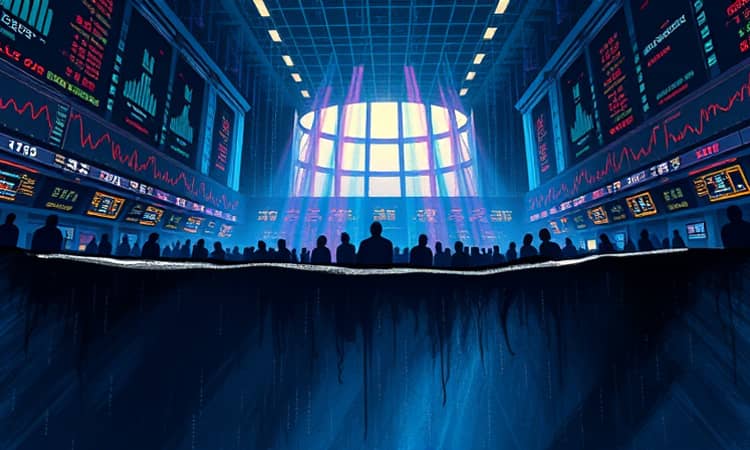
In the shadows of global finance, a secretive world thrives where massive trades take place away from prying eyes. Private exchanges or alternative trading systems, known as dark pools, facilitate these undisclosed transactions, reshaping how institutions move capital.
History and Growth
Dark pools evolved from informal "upstairs trading" desks of the 1970s, providing anonymity for block trades that could sway public markets. For decades, these private forums handled just 3–5% of equity volume, quietly matching large buy and sell orders.
Following technological advances and regulatory shifts, dark pool activity surged. By 2008, they accounted for 26% of U.S. stock trades. In 2012, more than half of equity volume was processed through over 50 registered U.S. dark pools. By January 2025, Bloomberg reported that dark pool share exceeded 51.8% of U.S. stock trades—a third consecutive month above the 50% mark.
How Dark Pools Operate
Unlike public exchanges, dark pools offer anonymity in large block transactions. Institutional participants submit orders without revealing size, identity, or timing. Execution methods include midpoint crosses, volume-weighted average price (VWAP) matches, or negotiated crosses at scheduled intervals.
- Independent dark pools run by third parties
- Broker-dealer owned venues with proprietary order flow
- Exchange-owned dark pools that interconnect with public markets
Access is restricted to hedge funds, pension funds, mutual funds, insurance companies, and banks—retail investors are generally excluded. Some platforms, labeled "grey pools," partially interact with lit markets to fulfill certain order types.
Advantages
For institutions, dark pools offer three core benefits:
- Reduced market impact and sudden price swings: Large orders match privately, preserving public price stability.
- Cost efficiency through lower fees and midpoint pricing: Trades often execute at the bid-ask midpoint, securing incremental gains.
- Protection from predatory high-frequency traders: Hidden orders limit exposure to algorithmic front-running.
These features enable pension funds or mutual funds to rebalance portfolios without broadcasting intentions that could trigger adverse movements.
Disadvantages and Risks
Dark pools bring significant caveats for market health and fairness:
- Impaired price discovery and fairness: Hidden volumes distort supply-demand signals.
- Retail investor disadvantage from delayed information: Public traders react too late to post-trade reports.
- Potential conflicts and information leakage: Payment for order flow or priority arrangements can bias executions.
Studies show that excessive dark trading may reduce overall market efficiency, with welfare losses when opaque volumes replace transparent lit-market transactions.
Key Statistics and Data
Regulatory Framework
Operating under SEC and FINRA oversight, dark pools adhere to lighter disclosure requirements than public exchanges. Pre-trade opacity is central to their design, though post-trade reporting to consolidated tapes remains mandatory. Enforcement actions in 2016 levied significant fines for regulatory violations exceeding $150 million against major institutions.
Regulators continue debating policy reforms to address post-trade reporting on consolidated tapes and tighten rules around order prioritization and payment for order flow, aiming to balance privacy with market integrity.
Market Impact and Examples
The GameStop saga of early 2021 highlighted dark pool effects: institutional sell orders hidden in private venues masked true supply, fueling retail confusion and exacerbated price volatility. High-frequency traders monitoring dark pools gained unfair edges, leveraging fragmented information.
Detecting dark activity involves watching for sudden spread shifts, unexplained volume surges, or mismatches between lit and dark market metrics. Analytical tools like dark pool scanners can signal hidden flows, offering traders early warnings.
Looking Ahead: Transparency vs. Privacy
As dark pool usage nears majority market share, stakeholders weigh the benefits of confidentiality against the need for open price formation. Critics argue that too much opacity erodes trust, while proponents insist that revealing large order intentions would disrupt institutional strategies and inflate costs.
Innovations such as hybrid models offering limited pre-trade disclosure or tiered transparency could bridge the divide. By integrating selective visibility without full public exposure, markets might achieve both fair price discovery and protection for sizable trades.
Ultimately, understanding dark pools empowers all market participants. Retail traders armed with awareness and analytical tools can navigate these hidden waters more confidently, while regulators refine frameworks to ensure equitable access and integrity.
In the intricate ecosystem of modern finance, dark pools remain a potent force—forcing us to question how much secrecy is justified in pursuit of efficient markets and how much transparency is vital for collective trust.