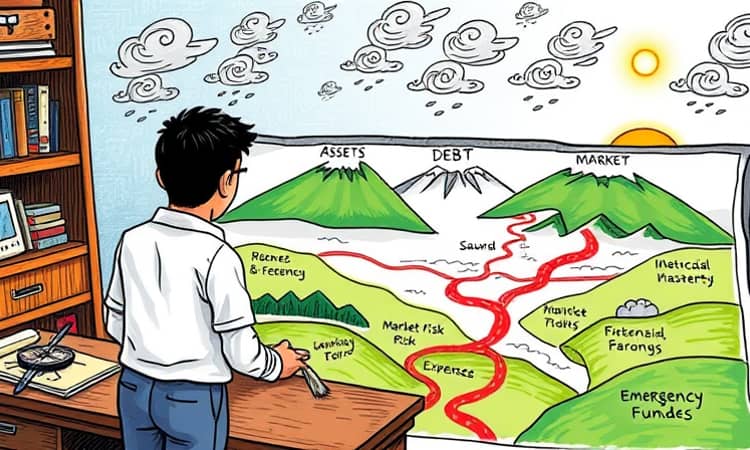
Imagine two friends, Anna and Ben. Both earn the same salary and live in the same city. When Anna faced an unexpected job loss, she navigated her finances with calm purpose, drawing on an emergency fund and insurance policies she had arranged. Ben, however, found himself overwhelmed by mounting bills, dipping into credit cards, and feeling trapped. What made the difference was that Anna had become the cartographer of her own finances, carefully sketching out potential hazards and laying down strategies well before any storm hit her shores.
Charting the Risk Landscape
As personal financial risk managers, readers must survey a broad terrain, comprised of both visible landmarks and hidden threats. The map of your financial world spans income sources, recurring expenses, debt obligations, tangible assets, and even intangible human capital. Overlaying these are diverse hazards—from market crashes to medical emergencies—and shifting weather patterns like inflation and economic cycles. By viewing your situation through the lens of a map, you cultivate a mindset of active exploration rather than passive vulnerability.
Within this framework, you can identify key regions:
- Income / Employment Risk: job loss, reduced hours, or business downturn.
- Expense & Lifestyle Risk: sudden large bills and lifestyle inflation.
- Health & Disability Risk: serious illness or injury affecting earnings.
- Longevity Risk: outliving retirement savings and resources.
- Investment / Market Risk: volatility, crashes, and sequence-of-returns issues.
- Inflation & Liquidity Risk: eroding purchasing power and lack of cash.
- Debt & Leverage Risk: high-interest obligations and overextension.
- Property & Liability Risk: damage, lawsuits, and legal exposures.
- Family & Life-Stage Risk: divorce, support for dependents, loss of a breadwinner.
Survey Your Terrain: Identifying and Classifying Risks
To begin drawing your map, adopt a structured risk assessment framework. This process transforms abstract worries into clear markers on your chart. Follow these essential steps:
- Identify Risks: Brainstorm events such as job loss, natural disasters, or cyber fraud.
- Assess Likelihood & Impact: Estimate probability and potential financial loss.
- Evaluate Capacity & Tolerance: Consider your savings, income stability, and comfort with uncertainty.
- Prioritize: Focus first on high-probability/high-impact hazards that threaten your core security.
By plotting each risk on a simple probability-impact matrix, you reveal which areas demand the most urgent attention. High-probability, non-diversifiable personal risks and immediate cash-flow dangers must occupy the center of your map, while lower-priority concerns can be monitored with periodic reviews.
Drawing Contours: Assessing Likelihood and Impact
Contours on a topographic map show elevation changes; in your financial chart, they illustrate variations in risk severity. Quantify each risk by estimating its probability—high, medium, or low—and its impact measured in months of expenses or as a percentage of net worth. For instance, losing your primary income without an emergency fund represents both high probability and high impact for most households.
Understanding your risk capacity and tolerance adds depth to this analysis. Risk capacity depends on objective factors like stable income, low debt levels, and substantial savings. Risk tolerance, by contrast, is a psychological measure of how you respond to the prospect of loss or volatility. Both dimensions guide you in choosing appropriate responses, ensuring your map reflects not only the terrain but also your own resilience profile.
Zoning and Building Codes: Choosing Strategies
Once hazards are charted and contours drawn, the next step is establishing zones where specific strategies apply. Financial risk management falls into five classic responses: avoidance, prevention, sharing, transference, and acceptance. Each strategy functions like a building code that determines what structures you can safely erect in a given region of your map.
Infrastructure and Continual Re-Mapping: Tools for Resilience
Infrastructure elements—like roads and bridges—support daily travel across a landscape. In your financial map, these are the tools that keep your plan functional under stress. Key components include:
- 3–6 months of living expenses in an emergency fund, extended to 6–12 months for variable-income households.
- A robust insurance suite covering health, disability, life, home, auto, and liability risks.
- Broad diversification—spreading investments across equities, bonds, real estate, and cash to buffer market volatility.
- A disciplined budgeting system that distinguishes necessities from discretionary spending.
- A debt management plan prioritizing the elimination of high-interest obligations.
These elements form the highways and safety railings that keep your financial journey on course. Regularly inspecting and reinforcing this infrastructure ensures you’re prepared when unpredictable weather rolls in.
Maintaining Your Map: Ongoing Review and Adaptation
Your financial territory is not static; economic cycles shift, personal circumstances evolve, and new risks emerge. Schedule routine map reviews—quarterly or biannually—to update your contours, redraw hazard zones, and recalibrate strategies. After life events like marriage, parenthood, or career changes, re-survey your terrain to ensure your plan remains aligned with your goals and capacities.
Conclusion: Empowerment Through Mapping
Becoming a financial cartographer transforms you from a passive passenger into the confident navigator of your own journey. By charting your terrain, drawing precise contours of risk, zoning protective strategies, and building resilient infrastructure, you craft a living map that guides every decision. As you maintain and refine this map over time, you gain both clarity and courage to face uncertainties with purpose and poise. Embrace the role of cartographer, and let your meticulously drawn plan lead you toward secure and prosperous horizons.