In an era of rapid market shifts and global uncertainty, understanding the forces shaping our economic future is crucial.
Why Economies Mirror the Weather
Professional meteorologists spend their days analyzing maps, radar, satellites to predict weather patterns with precision. Similarly, a macro strategist or chief economist studies GDP reports, inflation readings, and credit spreads to anticipate market moves. Just as clouds and storms gather in our atmosphere, economic indicators coalesce to reveal impending expansions or downturns. By treating the financial world like an atmospheric system, we gain a richer framework for understanding trends and preparing for turbulent times.
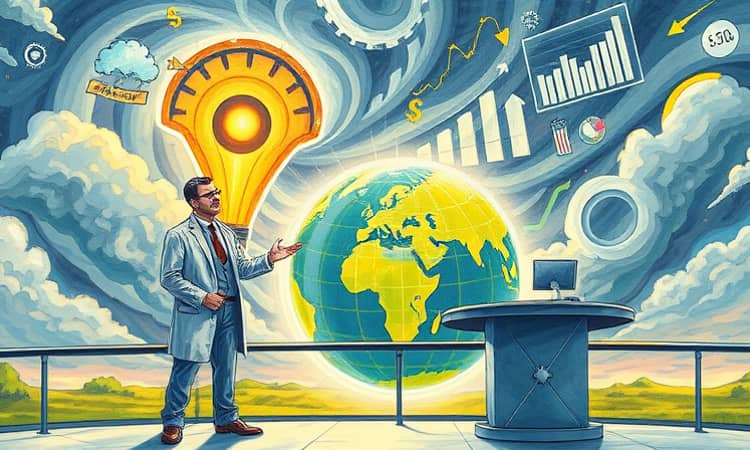
At the heart of this analogy lies the belief that both weather and economics operate as complex systems driven by observable forces and underlying structures. Wind currents become capital flows, barometric pressure mimics financial conditions, and temperature translates to growth rates. Viewing data through this lens empowers analysts to become true financial meteorologists who predict market storms, guiding investors and policymakers alike.
Gathering Data: From Satellites to Surveys
Meteorologists rely on a vast network of satellites, weather stations, and balloons to monitor atmospheric conditions in real time. In the financial world, economists harness an equally diverse set of observation tools to capture the pulse of the economy. This comprehensive data collection is the foundation upon which reliable forecasts are built, enabling experts to measure every economic pulse and refine their outlook as new information emerges.
- Official statistics like GDP, CPI, and unemployment reports.
- High-frequency private data such as credit-card transactions and mobility metrics.
- Market-based indicators including yield curves, credit spreads, and volatility indices.
- Survey-based measures like consumer confidence and business sentiment readings.
With these instruments in hand, a financial meteorologist assembles a detailed picture of current conditions, much like mapping a developing storm. Every datapoint contributes to an ensemble of signals that inform projections for the coming quarters or years.
Mapping Analogies: From Airflows to Capital Flows
To illustrate the parallels, consider this concise table where leading meteorological concepts meet their economic equivalents:
This structured comparison highlights how econometricians and market strategists employ tactics reminiscent of atmospheric scientists, translating scientific rigor into monetary insights.
Modeling Storms: Short-Term vs Long-Term Forecasts
Meteorologists produce both short-range forecasts—predicting tomorrow’s rain—and long-range climate models that span seasons or decades. Likewise, financial experts split their focus between immediate market movements and overarching secular trends.
Short-term predictions address quarterly GDP changes, next month’s inflation print, or central bank rate decisions. They are akin to daily weather reports that warn of storms or heatwaves on the horizon. In contrast, long-term climate analysis considers demographic shifts, technological innovation, and debt accumulation—forces that shape decades of economic performance.
- Recessions as hurricanes: build-up of debt, sudden downturn, policy response.
- Financial crises like flash floods: rapid liquidity shortages and localized damage.
- Inflation waves as heatwaves: persistent price rises straining incomes.
- Deflation snaps resembling cold fronts: collapsing demand and prolonged stagnation.
By distinguishing these horizons, the financial meteorologist can guide resource allocation, investment strategies, and policy frameworks with both immediacy and foresight.
Communicating Risks and Warnings
One of the defining roles of a weather forecaster is to issue timely warning signals before a tornado or flood. In economics, the challenge is similar: to convey complex findings to central banks, corporate boards, and individual investors with clarity and appropriate urgency. Tailoring the message ensures that emergency measures—like stimulus packages or risk hedges—are deployed effectively.
Whether drafting a research note or briefing a treasury team, the financial meteorologist translates dense model outputs into actionable guidance. By translate uncertainty into actionable insights, they empower decision-makers to navigate market volatility and protect assets against systemic shocks.
Managing Uncertainty: The Ensemble Approach
Understanding that no forecast is perfect, meteorologists run multiple model simulations—known as ensembles—to capture a range of possible outcomes. This method acknowledges inherent unpredictability while revealing the most probable paths. Similarly, economists employ various scenarios, from dovish policy environments to high-inflation surprises, to build resilience into their planning.
Capture the full probability range by assigning probabilities to different economic regimes and updating those probabilities as data arrive. Whether a central bank pivot or geopolitical event occurs, the financial meteorologist recalibrates assumptions after each shock to maintain forecast integrity.
Continual Refinement: Learning from Every Storm
After every major hurricane or flood, meteorologists dissect what went right and wrong, improving models for the next event. In finance, the review process following a crisis—be it the Global Financial Crisis, the COVID shock, or an inflation surge—drives model updates and research breakthroughs. This ongoing cycle of analysis and enhancement ensures that forecasters remain at the cutting edge, prepared to anticipate the next economic tempest.
By calibrate assumptions after each major shock, financial meteorologists refine their tools, incorporating new data sources and behavioral insights for ever-more-accurate predictions.
Conclusions: Embracing the Role of the Financial Meteorologist
In an interconnected global economy, the stakes of forecasting have never been higher. Embracing the meteorological metaphor provides a compelling roadmap for data collection, modeling, communication, and innovation. As financial markets face increasing volatility—from climate policy transitions to technological disruptions—the need for skilled economists who can monitor liquidity and leverage levels and guide investors becomes paramount.
Through robust data networks, ensemble scenarios, and clear risk communication, the financial meteorologist stands as a guardian against unseen threats and a navigator toward clearer financial skies. By adopting the discipline, tools, and mindset of atmospheric scientists, economic forecasters can deliver the insights necessary to thrive in uncertain times, ultimately fostering stability and growth in the global economy.