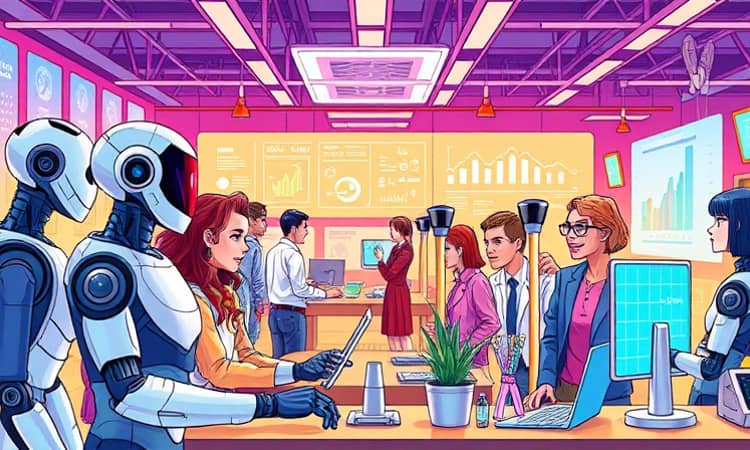
As we look ahead to the next decade, rapid technological change, shifting labor dynamics, and evolving worker expectations promise to redefine how industries operate, hire, and compete. Understanding these transformations is critical for business leaders, policymakers, and individuals seeking to thrive.
Macro Forces Reshaping the Workplace
A confluence of global trends is steering us toward an era where efficiency overtakes expansion, and skills determine success. In the coming years, organizations will focus on optimizing resources, automating routine tasks, and investing in human capital development as economic pressures mount.
Key drivers of this shift include:
- AI and automation scaling across sectors
- Labor market realignment amid economic slowdown
- Global talent shortages and increased mobility
- Erosion of perceived job security
We are transitioning from a growth and hiring paradigm to an efficiency and skills decade where capital is reallocated from headcount expansion to technology deployment and reskilling initiatives.
AI and Automation: Redefining Tasks
Advancements in artificial intelligence and robotic process automation are increasingly penetrating non-routine activities, moving well beyond simple rule-based tasks.
Organizations across industries report cross-functional penetration across sectors as AI takes on roles such as contract drafting, customer support triage, financial reconciliations, defect detection on manufacturing lines, and diagnostic assistance in healthcare.
The impact on job structures is significant. Entry-level professional positions—paralegals, junior analysts, administrative assistants—face compression, while mid-to-senior roles evolve to focus on strategy, oversight, and creative problem solving. This shift is forcing an estimated 12 million U.S. workers to consider different career pathways by 2030.
Occupational Shifts: White-collar vs. Blue-collar
The fallout from automation is not evenly distributed. White-collar roles are consolidating at higher levels of complexity, while blue-collar opportunities are on the rise, particularly in sectors driven by infrastructure investment and the energy transition.
As traditional entry-level white-collar roles contract, many workers are finding financial stability and upward mobility in blue-collar fields. Educational institutions and community colleges are responding with expanded vocational programs and apprenticeships to meet this demand.
Employers and governments that invest in these pathways can tap into new labor pools while addressing regional imbalances and migration trends.
Flexible Models and the Hybrid Evolution
Work location has become situational rather than fixed, allowing organizations to optimize space and employees to balance personal and professional commitments.
While some firms push return-to-office mandates amid softening labor markets, forward-thinking organizations adopt role-based flexible models that view flexibility as a driver of engagement and retention, particularly for caregivers and underrepresented groups.
Long-term, we expect an uneven landscape: data-sensitive industries and highly collaborative environments will lean toward office-centric work, whereas tech, creative, and certain professional services maintain hybrid or remote options.
Rise of the Gig Economy and Polyworking
The gig economy continues its rapid expansion, projected to grow from $674 billion in 2026 to over $2.5 trillion by 2035. Driven by autonomy and earning potential, professionals increasingly assemble portfolio careers.
- Flexible projects that complement full-time roles
- Internal talent marketplaces offering gig-like assignments
- Platforms supporting contractor compliance and onboarding
Many individuals now embrace portfolio careers mixing multiple income streams, balancing the creative freedom and pay premiums of freelance work against the volatility and administrative burdens of self-employment.
This trend spurs demand for innovative solutions in payroll, benefits portability, and contractor management, while policy debates intensify around classification and social safety nets.
Skills and Upskilling: The New Currency
With technical competencies becoming obsolete faster than ever, continuous learning has emerged as a critical meta-skill. Organizations that neglect reskilling risk widening inequality and talent churn.
Experts project that nearly 39% of employees’ skill sets will be transformed by 2030. In response, 81% of C-suite executives plan to adopt skills-based hiring, valuing practical proficiency over formal degrees.
- AI fluency and data literacy
- Communication and storytelling
- Cross-boundary collaboration and cultural agility
- Problem framing and critical thinking
- Cybersecurity hygiene and risk awareness
Leading firms, such as AT&T, have launched massive reskilling initiatives to build a continuous learning unlearning and relearning culture. Public-private partnerships and online platforms are filling gaps between academia and evolving workplace demands.
Charting a Path Forward
As industries adapt, companies that embrace automation while nurturing human potential will gain a competitive edge. Prioritizing skills-based pathways, flexible work arrangements, and robust reskilling programs is not just smart strategy—it is essential for survival.
For workers, cultivating adaptability, digital literacy, and specialized trade skills opens doors to rewarding careers. Policymakers and educators must collaborate to ensure infrastructure, training, and social supports keep pace with technological change.
Together, we can navigate this transition toward a more dynamic, inclusive, and purpose-driven world of work—one where innovation fuels opportunity and every individual can thrive.