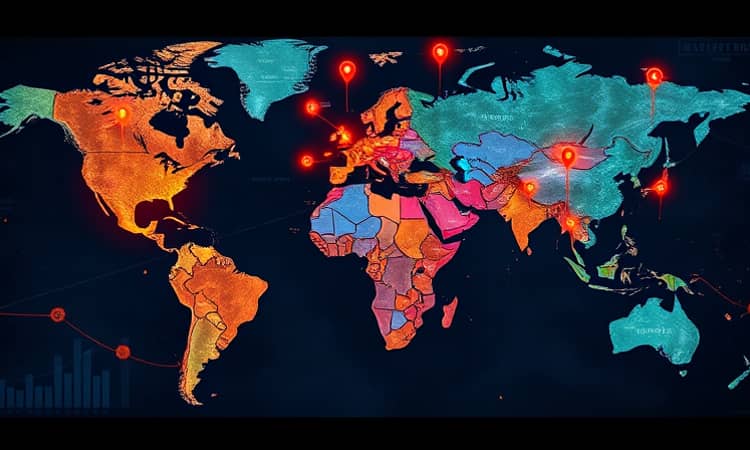
In an era where political divides crisscross borders, traditional credit analysis faces a fundamental shift. No longer enough to gauge growth projections or interest-rate paths, analysts and investors must embrace a comprehensive geopolitical risk framework that captures the multifaceted forces altering sovereign and corporate balance sheets.
Why Geopolitics is Central to Credit Risk
Leading agencies now assign equal weight to policy uncertainty and macroeconomic indicators. Moody’s 2026 global outlook warns that political risks outweigh pockets of resilience, downgrading the sovereign outlook to negative amid fiscal strains and fractured alliances. S&P, Fitch, and the World Economic Forum echo this sentiment, highlighting a surge in low-probability and high-impact shocks such as cyberattacks and climate disruptions.
Sanctions, tariffs, and defense spending have become core channels transmitting political friction into credit markets. Recent data show that defense budgets in Europe rose by over 10 percent year-on-year post-2025, while tariff volatility spiked trade finance costs by nearly 15 basis points in key corridors.
Baseline: 2026 Macro and Credit Environment
Global growth remains modestly stable. S&P projects roughly 3.2 percent expansion in 2026, buoyed by AI-led investments and accommodative financial conditions. Moody’s describes the outlook as subdued yet steady, noting default rates could recede in a benign scenario.
Still, the backdrop feels a stable but fragile outlook. Fitch reports that even a moderate geopolitical shock could unravel expected credit improvements. For sovereigns, high debt levels and weak fiscal buffers translate into a negative outlook. Banks appear resilient overall, but face threats from technology-driven disruption, climate regulations, and erratic policy shifts.
Transmission Channels from Geopolitics to Credit
Understanding how geopolitical dynamics morph into credit outcomes requires a structured lens. Seven key channels illustrate the pathways of risk and stress:
- Tariffs and export controls crimp corporate earnings, reshape supply chains, and pressure current-account balances.
- Conflict-driven price spikes fuel inflation and subsidies, squeezing external positions of net importers.
- Elevated defense budgets widen deficits and debts, hampering fiscal consolidation for sovereigns.
- Heightened political uncertainty raises funding costs, risking sudden stops across emerging markets.
- Policy polarization undermines long-term investment plans, eroding sovereign credit strength.
- Geopolitical shocks dent bank asset quality metrics, leading to tighter financing conditions.
- Climate disasters impose contingent liabilities on states, amplifying fiscal and external vulnerabilities.
Mapping these channels against credit metrics offers a granular view of potential stress points and rating shifts.
Key Geopolitical Flashpoints and Credit Implications
The global arena teems with hotspots where politics and credit intersect dangerously. Below we examine the most consequential in 2026.
Russia–Ukraine Conflict and European Credit
As conflict endures along the Russia–Ukraine border, structural risk indices place Eastern Europe among the highest-risk zones. Fitch, Moody’s, and S&P have collectively issued multiple negative outlooks and downgrades for directly exposed economies.
Energy security concerns remain acute. Europe’s reliance on imported gas and oil leaves sovereign spreads and corporate margins susceptible to supply disruptions. Concurrently, defense outlays surged over 12 percent in 2025, exacerbating fiscal deficits and delaying debt consolidation plans.
Middle East Tensions and Oil Market Risks
The Israel–Gaza conflict and broader regional strife drive volatility in oil markets and shipping routes. BBVA’s 2026 Country Risk Report flags this theater as a top source of external risk, noting that Red Sea disruptions pushed insurance premiums for cargo vessels up by nearly 20 percent.
For oil importers, higher energy bills widen current-account deficits and strain public finances. Emerging-market sovereigns with limited fiscal headroom face rising default probabilities if this volatility endures.
U.S.–China Strategic Competition
The “geoeconomic” turn sees trade barriers, export controls, and competing industrial subsidies reshape comparative advantage. Semiconductors, critical minerals, and clean-tech sectors find themselves on the frontlines as both powers vie for technological supremacy.
Investors in emerging markets must navigate fragmentation of global supply chains, while multinational corporations adjust capital expenditure amid unpredictable policy swings. Moody’s EM outlook stresses diversification of financing sources as a key resilience strategy.
Trade Wars and Tariff Volatility
Trade tensions reverberate through banking systems. S&P indicates that banks in Italy, Germany, and Ireland have the highest exposure to tariff-driven sectoral defaults. Variable-rate mortgages in Spain and the UK face margin compression under protracted trade-war scenarios.
Anticipating higher non-performing loans, lenders are tightening standards for industries reliant on cross-border trade, further amplifying credit constraints.
Emerging Hotspots and Systemic Uncertainty
Fitch’s hot spot roster extends beyond Europe and the Middle East to include Venezuela, parts of Asia, and select African states. Its analysis warns of an “emerging global order” marked by sanction regimes and the weaponization of interdependence in energy, technology, and finance.
Such systemic uncertainty fosters a climate where risk premia remain elevated and capital reallocations occur at breakneck speed.
Measuring Geopolitical Risk
Quantification tools are rising in prominence. BBVA’s Structural Geopolitical Risk (SGR) index, GDP-weighted and peaking in the early 2020s, highlights the escalation in political tensions and military buildups. Countries like Ukraine, Russia, Israel, and Iran rank highest on this metric.
European Parliament research further correlates spikes in geopolitical-risk indices with notable drops in bank profitability and widening credit spreads, underscoring the measurable impact of political shocks.
Integrating Geopolitical Analytics into Credit Strategy
To navigate this volatile environment, investors and risk managers must infuse geopolitical insights into every layer of credit assessment. This means blending economic forecasts with scenario analysis of political events and sanction trajectories.
- Incorporate structured geopolitical forecasts into financial models
- Conduct scenario-based stress tests on sovereign and corporate exposures
- Monitor policy shifts in key regions and update risk dashboards
- Diversify funding sources and employ dynamic hedging strategies
By weaving these practices into due diligence and portfolio management, stakeholders can anticipate dislocations and position themselves for resilience.
Conclusion: Embracing a Geopolitical Perspective
In today’s interconnected landscape, credit risk is inseparable from the ebb and flow of global politics. A robust analysis must go beyond traditional metrics to capture the undercurrents of tension, alliance, and policy maneuvering.
By adopting a holistic geopolitical risk framework, lenders, investors, and policymakers gain a strategic edge, enabling them to weather storms and seize opportunities that arise at the crossroads of politics and finance.