In an ever-shifting economy, investors and policymakers seek that elusive edge: a way to gaze into tomorrow’s trends today. Leading economic indicators serve as that edge, offering patterns and signals that move before the broader economy and help forecast turns in growth, inflation, and asset prices.
By understanding these measures—what they are, why they work, and their limits—you can sharpen your own economic outlook and strategic decisions.
Core Concepts and Definitions
An economic indicator is a statistic about economic activity—such as output, employment, or prices—that sheds light on current conditions and future trends. A leading indicator typically changes before overall economic growth and is prized for short-term prediction of turning points. In contrast, lagging indicators confirm trends after they’ve occurred (for example, the unemployment rate or consumer price index), while coincident indicators move roughly in line with the economy (industrial production, personal income).
Leading indicators are probabilistic, not oracular: they improve the odds of spotting inflection points early but carry noise and sometimes false alarms.
Main Indicator Families
Leading indicators can be grouped into three broad categories, each offering different insights and data sources:
- Market-based indicators: yield curve spreads, stock indexes, credit spreads
- Survey-based measures: purchasing managers’ indexes (PMIs), consumer confidence surveys
- Real-activity data: housing starts, durable goods orders, new business formations
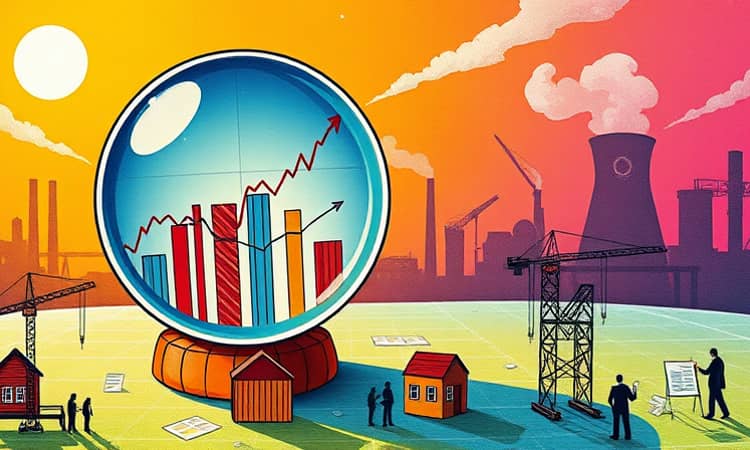
The LEI: A Composite Crystal Ball
The Conference Board’s Leading Economic Index (LEI) is the closest thing to a single, composite leading index for the U.S. economy. Designed to anticipate peaks and troughs in the business cycle roughly seven months in advance, the LEI combines multiple noisy series into one coherent gauge.
Each component is normalized and averaged to smooth volatility and highlight common turning points. Historically, when the LEI turns downward, real GDP growth and industrial production often follow suit within 4–10 months. As of July 2025, the LEI rose 0.2% month-over-month, suggesting continued moderate expansion ahead.
Economists, corporate planners, and asset managers use the LEI as a high-level early warning system for strategic planning and portfolio shifts.
Major Individual Indicators
Beyond composite indexes, several stand-alone indicators act as critical pieces of the market’s crystal ball:
Stock Market Indexes
Broad equity indexes like the S&P 500 are considered leading indicators because prices discount expected future earnings and policy shifts. Sustained uptrends often coincide with stronger growth expectations, while deep declines can presage recessions. However, market movements can diverge from fundamentals due to liquidity influxes, sentiment swings, or central bank interventions.
Yield Curve
The yield curve plots government bond yields across maturities; its slope—typically the difference between 10-year and 2-year Treasury yields—is one of the most closely watched signals. An inverted yield curve (short rates above long rates) historically precedes recessions by 6–18 months, reflecting market expectations of future rate cuts and slowing growth. Today’s 10-2 spread sits at -5 basis points, echoing caution among bond investors.
Housing Starts and Building Permits
Housing activity is sensitive to mortgage rates and financing conditions. Building permits grant authorization for new construction, while housing starts track projects underway. Together, they foreshadow construction and materials demand, feeding into employment and durable goods purchases. In June 2025, building permits rose 3.5% year-over-year, signaling resilience in the housing sector despite higher borrowing costs.
Manufacturing New Orders and Durable Goods
Durable goods orders, especially excluding transportation, and the new-orders component of PMIs serve as early gauges of manufacturing momentum. Orders today translate into production, employment, and shipments tomorrow, making these data points vital for supply chain planning. The ISM Manufacturing New Orders index stood at 52.4 in July, indicating modest expansion in factory orders.
Initial Jobless Claims
Weekly new unemployment insurance claims reveal hiring trends before the official unemployment rate moves. As firms slow hiring or begin layoffs, claims rise, often flagging downturns in advance. In late July 2025, claims hovered around 230,000—near historical lows—suggesting a still-tight labor market and ongoing consumer spending strength.
Survey-based Signals
Sentiment surveys capture expectations that drive spending and investment decisions. Two key measures are:
- Consumer Confidence Index: Gauges households’ views on current and future economic conditions; July 2025’s reading of 101.2 hints at cautious optimism.
- Purchasing Managers’ Index (PMI): Tracks expansion or contraction in manufacturing and services; a composite reading above 50 signals growth. The global manufacturing PMI clocked in at 50.8 in June.
Putting It All Together
No single indicator offers a perfect glimpse into the future. Leading measures can conflict—equities may rally even as the yield curve inverts, or housing permits could rise while consumer confidence softens. The key is to view them as a suite of complementary tools rather than an infallible oracle.
Seasonal factors, policy interventions, and global shocks can distort signals. Always interpret data within broader economic contexts and cross-check with coincident and lagging measures before drawing conclusions.
Conclusion
Leading economic indicators form the heart of the market’s crystal ball, offering foresight into business cycle turns. By blending composite indexes like the LEI with individual signals—stock markets, yield curves, housing data, manufacturing orders, jobless claims, and surveys—you gain a nuanced, forward-looking perspective.
Keep in mind that these indicators improve your odds but do not guarantee outcomes. Use them judiciously, monitor real-time releases, and stay adaptable. In doing so, you’ll be better equipped to navigate uncertainty and seize opportunities on the road ahead.