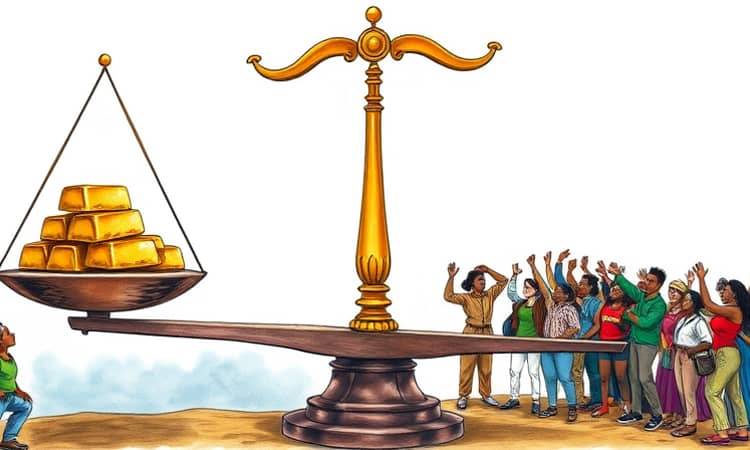
The world’s economic landscape is marked by profound contrasts, where fortunes accumulate at the top while millions struggle to make ends meet. This article delves into the facts, causes, and solutions surrounding global wealth inequality, and offers practical guidance for individuals, organizations, and policymakers committed to closing this divide.
Global Landscape of Wealth Inequality
Across the globe, the distribution of wealth is startlingly uneven. The top 10% owning roughly 75% of global wealth reveals how deeply concentrated assets have become. By comparison, the bottom 50% hold only 2% of wealth, a disparity that has only widened in recent decades.
In 2025, billionaire wealth reached $18.3 trillion, growing three times faster than average global income. Meanwhile, the richest 1% pocketed 20.3% of global income, up significantly since 1980. At the apex, the top 0.001% own three times more wealth than the entire bottom half of humanity.
- 2.8 billion adults constitute the bottom 50%
- 5.56 million belong to the top 10%
- Fewer than 60,000 individuals sit in the top 0.001%
These figures underscore a reality where economic gains are disproportionately captured by a tiny fraction of the population, leaving the majority with minimal resources to improve their lives.
Regional and Country-Level Disparities
Wealth inequality varies drastically by region. In North America and Oceania, the ratio of wealth between the top 10% and bottom 50% exceeds 520:1. In Sub-Saharan Africa, the gap stands at 260:1, while in Europe—despite lower income inequality—the ratio remains nearly 200:1.
At the national level, Gini coefficients highlight the extremes:
These numbers demonstrate that within-country inequality can be as severe as global trends, often fueled by historical, political, and economic legacies.
Historical Trends and Systemic Drivers
Over the past two centuries, total global wealth and output have soared. Yet, the benefits of this growth have not been shared equally. Since the 1990s, the wealth of billionaires and centi-millionaires has grown at an annual rate of around 8%, double that of the bottom half of the population.
Several systemic drivers perpetuate these imbalances:
- Education gaps: Spending per child in Sub-Saharan Africa is €200 versus €9,000 in North America.
- Financial flows: Approximately 1% of global GDP flows from poor to rich countries each year.
- Tax avoidance: Corporate and personal tax avoidance drains public resources.
Globalization, technological change, and policy choices have accelerated wealth concentration, making inequality a resilient phenomenon even amid economic expansion.
Consequences of Extreme Inequality
High levels of wealth disparity undermine social cohesion, hamper economic mobility, and fuel political instability. When a small elite controls vast resources, public trust erodes, and social safety nets weaken, leaving vulnerable communities without adequate support.
Moreover, inequality harms long-term growth. Research indicates that economies with extreme disparities tend to underinvest in education, health, and infrastructure, leading to a cycle of low productivity and persistent poverty.
Strategies for Bridging the Divide
Closing the wealth gap requires coordinated action at multiple levels. Key policy levers include:
- Progressive taxation: Introducing or strengthening wealth and inheritance taxes to curb excessive accumulation.
- Education investment: Ensuring equal access to quality schooling for all children, regardless of background.
- Financial reform: Regulating global capital flows and improving transparency to reduce illicit transfers.
Civil society and private sector initiatives also play a vital role. Impact investing, fair wage campaigns, and community ownership models can redirect resources and foster inclusive growth.
Empowering Individuals and Communities
Every person can contribute to reducing inequality. Simple actions include supporting businesses that prioritize fair wages, advocating for progressive policies, and volunteering with organizations that expand educational and economic opportunities.
Philanthropy, when aligned with systemic change, can amplify impact. Strategic grants that fund policy research, grassroots organizing, and capacity building help create environments where equity can flourish.
Looking Forward: A Call to Collective Action
The widening wealth gap is not inevitable. By harnessing collective responsibility and global solidarity, we can design systems that distribute resources more justly and sustainably.
Policymakers must enact reforms that target the structural roots of inequality, while individuals and communities hold leaders accountable. Together, we can foster an economy where prosperity is shared, opportunities are accessible, and dignity is upheld for all.
Bridging the wealth divide demands bold vision and persistent effort. Let this be our moment to champion fairness, extend compassion, and build a future in which everyone benefits from the world’s prosperity.